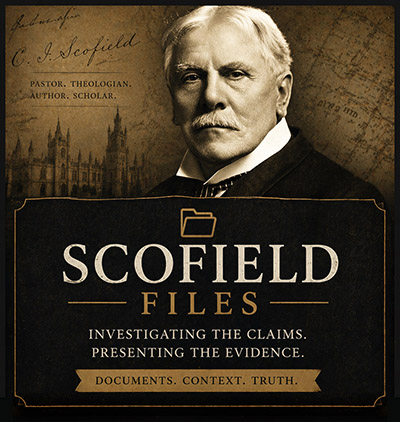
The Scofield–Rothschild Claim
A Documentary and Historical Analysis
Executive Summary
This study examines the modern claim that the Scofield Reference Bible (1909, 1st edition), edited by C. I. Scofield and published by Oxford University Press, was produced under the influence and financial backing of Zionist interests, particularly the Rothschild family. In recent years, this allegation has spread widely through podcasts, social media, online commentary, and conspiracy-oriented publications, often presented as established historical fact. Proponents of the theory commonly argue that Scofield’s theological notes were intended to influence American Christians to become more sympathetic to the eventual establishment of a Jewish state in Palestine. This study evaluates those claims through a review of primary historical documents, contemporaneous biographies, publishing history, and the modern sources from which the theory originated and developed.
This study will conduct a comprehensive review of:
- contemporaneous biographical sources
- early 20th-century documentation
- late 20th and early 21st century secondary literature
The evidence will demonstrate that:
- No primary documentation supports the allegations
- The claims originate in speculative modern literature (post-1988)
- Later authors expand the initial claims without introducing new evidence
The evidentiary record instead reflects a pattern of:
Speculation → Exaggeration → Repetition
1. Scope and Methodology
This investigative article distinguishes between:
- Primary sources (documents, biographies, contemporaneous accounts)
- Secondary claims (modern authors proposing or repeating a theory)
2. Primary Historical Sources
2.1 Charles G. Trumbull (1920)
Charles Gallaudet Trumbull (1872–1941) was an American evangelical writer, editor, and longtime editor of The Sunday School Times, one of the most influential Protestant publications of the early twentieth century. A close associate of C. I. Scofield, Trumbull authored one of the earliest biographical accounts of Scofield’s life and ministry. His writings provide important contemporaneous insight into Scofield’s theological development, personal relationships, and the historical context surrounding the publication of the Scofield Reference Bible.
Source: Trumbull, Charles G. The Life Story of C. I. Scofield. New York: Oxford University Press, 1920.
https://www.agathonlibrary.com/wp-content/uploads/2022/01/Life-Story-of-C-I-Scofield.pdf
Trumbull provides a near-contemporaneous biography of Scofield. His work details:
- Scofield’s ministry
- development of the Reference Bible
- personal and theological influences
Crucial observation: Contrary to the claims of conspiracy theorists, no reference is made to:
- Zionist coordination
- Rothschild funding
- External political sponsorship
2.2 Arno C. Gaebelein (1943)
Arno Clemens Gaebelein (1861–1945) was a German-American evangelist, Bible teacher, and prominent early dispensational writer closely associated with the prophetic movement of the late nineteenth and early twentieth centuries. A contemporary and associate of C. I. Scofield, Gaebelein became widely known through his publication Our Hope and his extensive writings on biblical prophecy and Israel. His work The History of the Scofield Reference Bible (1943) remains one of the most important firsthand historical accounts of the Bible’s development, financing, and publication history.
Source: Gaebelein, Arno C. The History of the Scofield Reference Bible. New York: Our Hope Publications, 1943.
https://www.brethrenarchive.org/media/365384/gaebelein-a-c-_-the-history-of-the-scofield-reference-bible.pdf
Gaebelein gives a direct historical account of the Scofield Reference Bible’s production. Specifically, he also explicitly identifies four of the five known financial supporters:
- Alwyn Ball
- John T. Pirie
- John B. Buss
- Francis E. Fitch
These are documented, successful individuals—not anonymous or speculative figures.
3. Origin of the Modern Claim
Research indicates that the first documented claim of any Zionist involvement with Scofield was not until 1988, almost 80 years after the 1st edition of the Scofield Reference Bible was published.
3.1 Joseph M. Canfield (1988)
Joseph M. Canfield was an independent religious writer and critic associated with anti-dispensationalist and anti-Zionist currents within conservative Christianity, strongly opposing the prophetic system popularized by C. I. Scofield and later evangelical Christian Zionism. His biographical examination of Scofield and Dispensationalism (The Incredible Scofield and His Book) was his only published work.
Source: Canfield, Joseph M. The Incredible Scofield and His Book. Vallecito, CA: Ross House Books, 1988.
https://pdfcoffee.com/the-incredible-scofield-and-his-book-pdf-free.html
This is the first identifiable source introducing the Zionist conspiracy theory. It is important to note that his biography of Scofield was written primarily as a criticism of Scofield’s theological position (Dispensationalism) which substantially undermines its objectivity. As author Loraine Boettner noted: “This is one of the most powerful books that has ever been written against the dispensational system.”
His primary charge against Scofield is that he may have been influenced by the Zionist Samuel Untermyer, a fellow member of the Lotos Club in New York. When it comes to his assumptions, Canfield does not present documented proof or third-party quotes to validate his theories. Instead, he relies on:
- inferred associations
- speculative phrasing
- rhetorical questioning
“The admission of Scofield to the Lotos Club … strengthens the suspicion … that someone was directing the career of C. I. Scofield.” (page 174)
“There must have been anticipation…” (page 174)
“…we assume… that someone felt that Scofield could qualify…” (page 173)
“The (Lotos Club) included Samuel Untermeyer… a notorious criminal lawyer.” (page 174)
“A possible clue-Scofield’s “postponed Kingdom” theory… was most helpful in getting Fundamental Christians to back the international interest in one of Untermeyer’s pet projects–the Zionist Movement.” (page 174)
Analytical Observation
Canfield’s argument is explicitly tentative. Language such as “we assume,” “a possible clue,” and “the suspicion” indicates conjecture, not established fact. The foundation of his assumption is that Samuel Untermyer (a Jewish lawyer) must have influenced C.I. Scofield in the creation of the Scofield Reference Bible. No contemporaneous documentation has ever been produced connecting Scofield to Untermyer. This fundamental claim will be examined later in this document.
4. Escalation of the Claim
In the decade following Canfield’s initial suppositions, a pseudonymous online document circulated, known as “The Unified Conspiracy Theory.” Apparently written under the pen name Llwydawg the Hewer (and possibly by Grugyn Silverbristle) it proposed a series of vast Jewish conspiracies reaching back nearly 2000 years. It included assertions that Scofield was directed by Zionist handlers to create and publish the Scofield Reference Bible. Later writers borrowed from either Canfield or “The Unified Conspiracy Theory” thereby completing the transition from: speculation → assertion (exaggeration)
4.1 The Unified Conspiracy Theory (1999)
https://www.mail-archive.com/ctrl%40listserv.aol.com/msg18377.html
“(Scofield) was taken under the wing of Samuel Untermeier…”
“Untermeier introduced Scofield to numerous Zionist and socialist leaders…”
“Zionist…leaders… were the people who financed Scofield’s research trips to Oxford and arranged the publication and distribution of his (reference bible).”
“Scofield served as the agent by which the Zionists paralyzed Christianity.”
“Following (Scofield’s) Illuminati connections…”
“Untermeier introduced Scofield to numerous Zionist and socialist leaders, including Samuel Gompers, Fiorello LaGuardia, Abraham Straus, Bernard Baruch and Jacob Schiff.”
Analytical Observation
These allegations are presented as fact with no supporting documentation. There is no evidence that Scofield and Untermyer were acquainted with one another. The listing of the five Jewish men (Samuel Gompers, Fiorello LaGuardia, Abraham Straus, Bernard Baruch and Jacob Schiff) is a common technique in conspiracy articles of this era, as these types of details create the illusion of research and credibility. Implicating the Illuminati is almost a given for any and all Jewish conspiracies. Extensive research has turned up no primary evidence of any connection between Scofield and any of these five Jewish men.
4.2 Charles E. Carlson (2002)
Charles (C. E.) Carlson was a mid-20th-century Christian polemicist best known for criticizing dispensational theology and Christian Zionism. His writings promoted a covenantal, anti-dispensational interpretation of prophecy and later influenced several anti-Scofield and conspiracy-oriented writers. Carlson was an early internet popularizer of the types of claims in “The Unified Conspiracy Theory.” Sometime on or before November 30, 2002, he published an online article titled: “The Zionist-created Scofield “Bible”.”
https://historicist.info/articles2/zionscofield2.htm
“World Zionist leaders initiated a program to change America and its religious orientation. One of the tools used… was… Cyrus I. Schofield”
“The scheme was to alter the Christian view of Zionism by creating… a pro-Zionist subculture within Christianity. Scofield’s role was to re-write the King James Version (Bible)…”
“The Oxford University Press used Scofield…”
Analytical Observation
Carlson parrots the primary assumptions of Canfield and a few of the main points of “The Unified Conspiracy Theory.” Just like many conspiracy theorists, he exaggerates with a grand, global scheme which was a worldwide Zionist “program to change America.” It is noteworthy that over one hundred years of investigation has revealed no evidence of this supposed global, multi-decade subversion. There are no documents, articles, letters, or financial transactions which have been brought forward to demonstrate any of these sweeping allegations.
4.3 Michael Collins Piper (2004)
Michael Collins Piper was an American political writer and conspiracy-oriented author best known for works linking intelligence agencies, organized crime, and Israeli/Zionist influence to major historical events. He wrote for publications associated with the populist far-right and became especially known for expanding conspiratorial narratives surrounding John F. Kennedy’s assassination. In his 2004 book The High Priests of War, Piper specifically highlights the theory that the Rothschild family were behind the effort to use Scofield.
Source: Piper, Michael Collins. The High Priests of War. Washington, DC: American Free Press, 2004.
https://pdfcoffee.com/the-high-priests-of-war-pdf-free.html
“…Scofield’s dispensationalism was actively promoted and funded by the Rothschild family of Europe for the very purpose of advancing the Zionist cause and for fostering a push for an imperial global order” (page 79)
Analytical Observation
Piper is one of the first to directly implicate the (Jewish) Rothschild family in the Scofield conspiracy. Most theories about Jewish global influence or domination will involve either the Illuminati or the Rothschild family. Piper asserts that Scofield’s dispensationalism was “actively promoted and funded” by a powerful Jewish banking dynasty, but it is presented without evidence or documentation.
Assertion without substantiation is the hallmark of these types of documents.
4.4 David W. Lutz (2005)
David W. Lutz is an American scholar and theologian whose writings often engage critically with Dispensationalism, examining its development and assumptions within the broader history of evangelical thought. His chapter: “Unjust War Theory: Christian Zionism and the Road to Jerusalem” is nestled within the pages of the book Neo-Conned! Again, Hypocrisy, Lawlessness, and the Rape of Iraq.
Source: Lutz, David W. “Unjust War Theory: Christian Zionism and the Road to Jerusalem.” In Neo-Conned! Again, Hypocrisy, Lawlessness, and the Rape of Iraq (Light in the Darkness Publications, 2005). Link: unavailable
“…the histories of Protestant and Jewish Zionism is the relationship between Scofield and Samuel Untermeyer… a wealthy… Jewish Zionist.” (page 147)
“Untermeyer used Scofied… to inject Zionist ideas in American Protestantism.” (page 147)
“Untermeyer and other wealthy and influential Zionists whom he introduced to Scofield promoted and funded the latter’s career…” (page 147)
Analytical Observation
Lutz leans heavily upon Canfield’s assumptions, correctly noting that everything within this conspiracy hinges upon a Scofield-Untermyer connection. There are echoes of C.E. Carlson in the phrase “inject Zionist ideas in American Protestantism.” Once again, Lutz makes or repeats assertions with no supporting evidence.
4.5 Robert Singer (2009)
Robert Singer described himself as “a retired information technology professional and an environmental activist living in southern California.” His 2009 article, “The Scofield Bible, Oxford Publishing and the House of Rothschild,” appears to have circulated primarily through conspiracy-oriented and anti-Zionist websites such as Whale.to and derivative blogs. The article synthesizes and expands earlier themes from Michael Collins Piper and David W. Lutz, combining anti-dispensational arguments with broader Rothschild/New World Order conspiracy claims.
Source: Singer, Robert. “The Scofield Bible, Oxford Publishing, and the House of Rothschild.” www.whale.to (2009).
https://web.archive.org/web/20120309225452/http://www.whale.to/a/scofield_bible1.html
“The Scofield Bible was financed by the House of Rothchild with the sole purpose of promoting the Zionist Agenda.” (header of article)
“Rothschild Backed Zionist Jews (RBZJ) and… Scofield were used to change America and its religious orientation by the use of the Scofield Reference Bible from Oxford University Press.”
“Scofield, after being released from prison was introduced to Samuel Untermeyer, the President of the Koren Hayesod”
“Untermeyer… was instrumental in… the financing of Scofield’s Reference Bible.”
Analytical Observation
Singer repeats Piper’s insistence that the Rothschild family was involved in the effort to bring about the Scofield Reference Bible but yet provides no primary documentation to support his claim. He employs C.E. Carlson’s exact wording “to change America” and borrows from Canfield’s Scofield-Untermyer partnership, indicating that Untermyer helped to secure funding for the study Bible. Piper had used the phrase “very purpose” and Singer here modifies it to “sole purpose.” This is the hallmark of conspiracy theory articles, borrowing and repeating one another typically without providing citations or attribution.
He boldly asserts that Scofield was in prison, but even Canfield admitted that no evidence for this could be found. Scofield did spend time in two local city jails (Milwaukee and St. Louis) for possible forgery in the late 1870s but both cases were dropped. The earliest that Scofield could have met Untermyer was around 1900, over twenty years after his short jail time, but Singer compresses that in deceptive phrasing: “Scofield, after being released from prison was introduced to Samuel Untermeyer…”
Additionally, Untermyer did not become the President of Koren Hayesod until 1921, but Singer creates the insinuation that Untermyer was already the head of the major Zionist group when he possibly first met Scofield. Singer compresses forty years of potential history into one misleading sentence.
5. Critical Evaluation of the Core Claims
5.1 The Untermyer Association
One of the most persistent (and essential) claims surrounding C. I. Scofield is that he was associated with influential Zionist leader Samuel Untermyer (often spelled “Untermeyer” or “Untermeier”). The allegation is based primarily on circumstantial connections involving the Lotos Club in New York. However, no direct documentary evidence has surfaced showing that Untermyer even knew Scofield, or that he financed his work, or that he (and other wealthy Jews) controlled or influenced the Scofield Reference Bible project. The entire framework of this conspiracy theory hinges upon this one supposed relationship.
Key Problem:
- The Lotos Club had hundreds of members
- No evidence exists of: correspondence, collaboration, financial interaction
- Contemporary associates of Scofield never mention any Jewish influence
5.2 Chronological Inconsistency
- Scofield died: 1921
- Untermyer’s major Zionist activity: 1920s–1930s
Untermyer’s most prominent Zionist activity began within months of Scofield’s death.
5.3 Absence of Financial Evidence
Most conspiracy theories involving Scofield insist that wealthy Jews were financially involved in three areas: (1) Scofield’s time as a writer (1902-1909), (2) his travels to Europe, and (3) the printing, publication, and promotional costs associated with the study Bible. Various names are offered, including: Samuel Untermyer, Samuel Gompers, Fiorello LaGuardia, Abraham Straus, Bernard Baruch, and Jacob Schiff. To date, no documentation or evidence has been produced which could connect C.I. Scofield to any of these men. On the contrary, contemporaneous sources do provide the following information about the financial benefactors of the project:
- Five actual donors identified by name, some also by location
- some funding structure revealed
Arno C. Gaebelein served as a consulting editor on the Scofield Reference Bible. He recounts the origins and development of the project (including securing financial support and organizing contributors) while presenting the work as a straightforward product of evangelical initiative rather than hidden influence. Here are select quotes from his book The History of the Scofield Reference Bible:
“Mr. Fitch introduced the writer to… a… real estate broker, Alwyn Ball, Jr., a member of the large and successful firm of Southack & Ball. It was the beginning of the skyscraper days and Mr. Ball had distinguished himself in some large transactions… The next man I met was John T. Pirie, owner and New York representative of the Chicago department store, which still functions under the name of Carson, Pirie, Scott and Company.” (pages 37, 38)
“Alwyn Ball, Jr… fully endorsed the plan; and, better than that, Mr. Ball pledged a considerable sum of money to assist in the project. Then we mentioned the plan to John T. Pirie. He expressed his great delight, and without saying much, he did what Mr. Ball had done to help financially. Others… among them John B. Buss, of St. Louis, Mo., who also helped financially. Finally, the writer spoke to Francis E. Fitch, of New York… (he) likewise fell in line with the other brethren, heartily endorsing the proposed Bible.” (pages 48-50)
A fifth financial contributor, Lyman Stewart, is mentioned by Ernest R. Sandeen in The Roots of Fundamentalism: British and American Millenarianism, 1800–1930 (Univ. of Chicago Press, 1970, page 191). Stewart obtained his substantial wealth after being the co-founder of Union Oil Company of California (1890s). He provided the only known dollar amount donated ($1000 in 1908, the equivalent of $35,000 in 2026).
- Alwyn Ball, Jr: New York businessman, real estate broker with the Manhattan firm Frederick Southack & Alwyn Ball, Jr.
- John T. Pirie: Associated with Carson Pirie Scott & Company, one of the largest and most successful department store chains based in Chicago, Illinois.
- John B. Buss: St. Louis, Missouri businessman.
- Francis E. Fitch: Associated with the Exchange Printing Company in New York City.
- Lyman Stewart: Co-founder of Union Oil Company of California.
None of the five financiers identified by multiple sources were Jewish, and none had any known connections to Zionist organizations. All were successful in business and capable of financing Scofield and the publication of the Scofield Reference Bible.
6. Oxford University Press Context
Conspiracy-oriented writers have frequently alleged that influential Zionists either owned or influenced Oxford’s publishing operations or promoted the project. In these narratives, the widespread distribution of Scofield’s study Bible is portrayed as an effort to popularize dispensational theology and encourage evangelical support for Zionism. Unlike the lack of evidence from conspiracy theorists, we find key people, dates, and developments regarding publishing in Gaebelein’s book in an extensive passage:
“Publication of the Reference Bible was still a problem after Dr. Scofield had been at work on it for several years… Mr. Scott, of… the London publishing house of Morgan and Scott… at once raised the question, “Who will act as your publisher ?” He was rather astonished when he heard that none had been selected….(Mr. Scott) added, “There is only one publishing house which can handle your… Bible and that is the Oxford University Press.”… Mr. Scott took Dr. Scofield to the office of Mr. Henry Frowde, the chief of the great Oxford University Press… He became at once interested. But the head and manager of the American branch of the Oxford University Press had to be consulted. Mr. Armstrong enthusiastically endorsed the plan and urged the early publication of the Bible. Contracts were later drawn up and signed by both parties.” (pages 61, 62)
Some critics level the challenge that “It would be highly unlikely for a large printer like Oxford Press to be involved with such a project.” But, unlike today, at the beginning of the 20th century only a few printers in the world could accommodate manufacturing a large study Bible in significant quantities. Furthermore, out of that handful of potential companies, only two in England were officially authorized to print Bibles using the King James Version. The following article authored by Harry How (Strand Magazine, 1894. Link: https://archive.org/details/strand-1894-v-8) provides the details:
“Whilst the Universities of Oxford and Cambridge have a just claim to the copyright of the Revised Version, the copyright of the (KJV) is in the Crown, by whom the authority to print is given by patent to… the Universities of Oxford and Cambridge. Mr. Henry Frowde is the representative of the Oxford University Press…” (page 639)
Oxford University Press published the Scofield Reference Bible because:
- It held authorization to print the King James Bible
- It had the capacity to handle a large study Bible
- It was seeking to expand Bible publication operations
7. Repetition of the Claims
The tiny seed of Canfield’s initial assumption exploded in growth through twenty years of exaggeration within the fertile soil of imaginative speculation. The final stage just needed multiple authors, both in print and online, to simply repeat these allegations until the line between fact and fiction were hopelessly blurred for the average reader. Repeated assertions, especially when echoed across multiple platforms, can gradually acquire the appearance of legitimacy.
A variety of modern authors and online podcasters have propagated the narrative. In 2014, Alison Weir released her self-published book Against Our Better Judgment. She cites Canfield and Lutz and repeats their claims concerning Scofield, quoting Lutz at length.
On page 33 of the book Eagles Are Gathering (American Free Press, 2016) written by Merlin Miller, the author parrots the claim that Scofield was “hired by the Rothschilds” to pen his study Bible.
Numerous online articles seeking to link Scofield to Zionism have multiplied greatly in the past ten years. The problem for these investigative pieces is that they rarely cite their sources, or they invariably point back to unsubstantiated claims in Canfield, Piper, or Lutz. Here are a few representative samples:
- Cyrus Scofield and the Lotos Club: The Hidden Networks Behind the Theologian Who Shaped Evangelical Zionism (Douglas C. Youvan, 2025)
https://www.researchgate.net/publication/389653911_Cyrus_Scofield_and_the_Lotos_Club_The_Hidden_Networks_Behind_the_Theologian_Who_Shaped_Evangelical_Zionism - The Scofield Bible—The Book That Made Zionists of America’s Evangelical Christians (Maidhc Ó Cathail, 2015)
https://www.wrmea.org/2015-october/the-scofield-bible-the-book-that-made-zionists-of-americas-evangelical-christians.html - The Untold Story of Christian Zionism’s Rise to Power in the United States (Whitney Webb, 2019)
https://www.mintpressnews.com/untold-story-christian-zionists-power-united-states-israel/260532/
8. Pattern of Claim Development
The conspiracy theory regarding Scofield follows a consistent trajectory:
Stage 1 — AssumptionCanfield (1988)
Stage 2 — ExaggerationUnified Conspiracy Theory (1999), Carlson (2002), Piper (2004), Lutz (2005), Singer (2009)
Stage 3 — RepetitionWeir (2014), Miller (2016), online authors
9. Conclusion
The Scofield–Rothschild claim:
- lacks primary documentation
- originates in late speculative literature
- contradicts contemporaneous historical evidence
For more than a century, the claims surrounding C. I. Scofield, Zionist influence, and alleged Rothschild involvement have continued to evolve, not through the discovery of new documentary evidence, but rather through the repeated circulation of earlier speculation. Assertions first introduced cautiously and inferentially by late twentieth-century writers such as Canfield were gradually amplified by later authors, internet articles, podcasts, and social media commentary until conjecture itself began to acquire the appearance of historical fact.
Yet despite the confidence with which these accusations are often presented, no contemporaneous records, financial documents, correspondence, publishing contracts, or firsthand testimonies have surfaced demonstrating coordinated Zionist sponsorship of the Scofield Reference Bible. Instead, the historical trail consistently reveals a pattern of assumption, rhetorical escalation, and repetition, where claims are echoed from one source to another with diminishing scrutiny yet increasing certainty.